NewsJuly 1, 20268 Minutes
The Night Sky above Torre delle Stelle
Interview with Manuel Floris, astrophysicist, director of the Planetarium at L’Unione Sarda and science communicator
In Torre delle Stelle, the sky belongs as much to the place as the sea or the landscape itself. It lives in the name, in the atmosphere, and in the way the village feels once evening arrives. We asked Manuel Floris to help us understand what makes the sky above this stretch of coast so distinctive.
Where does your passion for astronomy come from, and what milestones shaped your personal and professional growth?
It goes back a long way, to my childhood. The night sky and the story of humankind in space held a powerful fascination for me, so much so that, at the age of eight, I built a small telescope of my own. After attending a scientific high school in Nuoro, I chose to study Physics in Cagliari, with astronomy always remaining the main point of reference. Later, I worked in the field of renewable energy research, while never losing my natural inclination toward scientific communications. Since 2011, I have been collaborating with the Unione Sarda Planetarium, which I now oversee and direct.
Torre delle Stelle is a place whose very name evokes the sky. Do you have a personal memory connected to it?
Yes, and it is one I remember with particular fondness. During my university years, I was actively involved with the Associazione Astrofili Sardi, and it was in Torre delle Stelle that I took part in a public skywatching event with them. We showed the Moon and the planets through a telescope, then broadened our gaze to the sky in search of nebulae and star clusters. That experience felt almost like a natural confirmation in that place with such an evocative name.
What makes the night sky in Torre delle Stelle different from what can be seen in other parts of Sardinia or the Mediterranean?
Torre delle Stelle has a very favorable position, because it looks out towards the sea, and especially towards the south-west. This means that part of the sky remains less affected by light pollution. It is, in one sense, a geographical detail, but it has a very concrete effect. It allows a significant portion of the night sky to be observed more clearly, with a visual quality that is often compromised elsewhere.
On the clearest nights, can the Milky Way really be seen from Torre delle Stelle, and which stars, planets, or constellations are visible throughout the seasons?
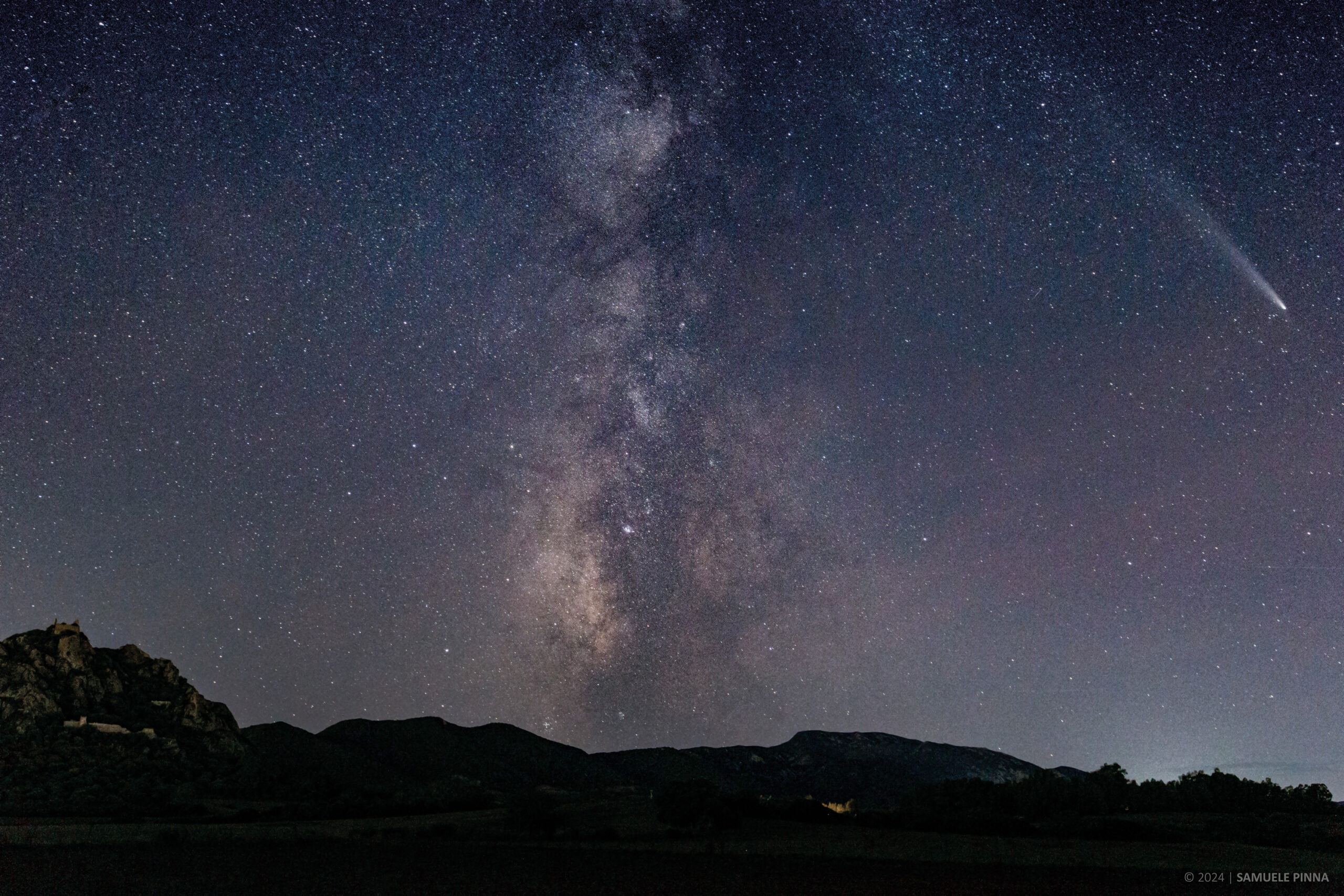
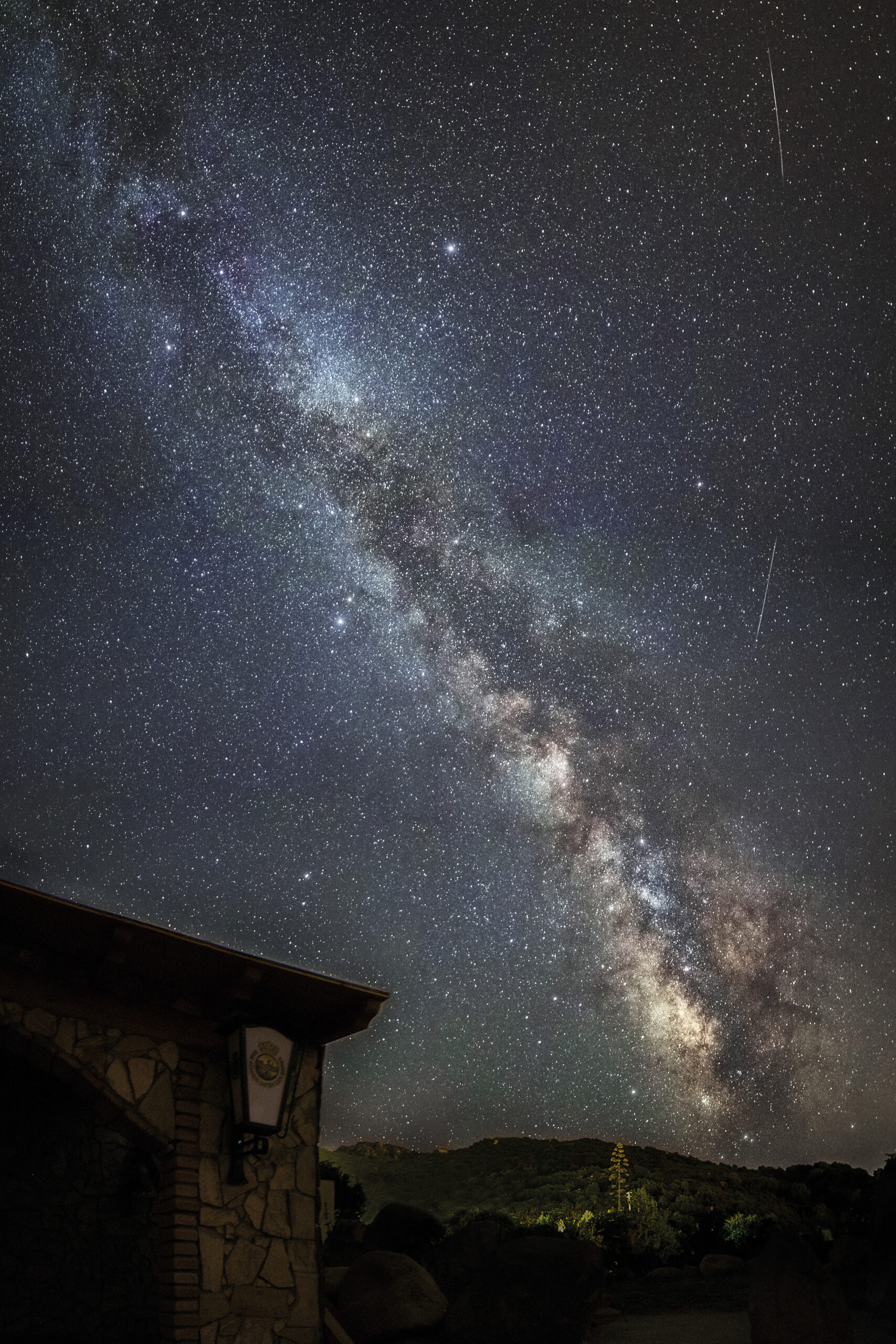
Yes, it certainly can. The Milky Way moves with the celestial sphere, and its brightest region, the galactic centre, is visible in the summer sky towards the south. That is why it can be seen from Torre delle Stelle on summer evenings. To observe it properly, however, one essential condition is required: true darkness. The eye must be allowed to adapt to the dark, and even the smallest light source nearby can interfere with that.
From Torre delle Stelle, one can also observe many of the brightest stars in the sky, along with a large number of constellations. Naturally, the sky changes with the seasons, and that is one of its most beautiful qualities. In the first part of summer, Venus will be clearly visible after sunset, while from the end of August, Saturn will once again be visible towards the south.
Is there a best time of year for observing the sky in Torre delle Stelle? If so, when is it?
If the Milky Way is the main objective, then summer is certainly the best season. But if we are speaking about the overall quality of the sky, the period from October to April often offers better conditions. With the closure of many hospitality businesses along the coast, light pollution decreases and the sky becomes darker again. This makes it possible to see a greater number of stars and to perceive the depth of the celestial landscape more fully.
What should a visitor do, in practical terms, to enjoy a starfilled night at its best? Where should they look, at what time, and with what precautions?
The first thing is to wait until the end of twilight, which comes at least an hour and a half after sunset. Then it is best to switch off the surrounding lights and remain in the dark for a few minutes, allowing the eye to adapt properly. Only then does the pupil dilate fully and begin to collect the faintest light of the stars. It is a simple step, but a decisive one. The sky requires time, silence, and a little patience.
A telescope can be used, of course, because it gathers light and allows us to see what the human eye cannot observe on its own, but it is not essential. Even a pair of binoculars can reveal stars and nebulae that remain invisible to the naked eye.
Is there a constellation, a planet, or a celestial phenomenon especially linked to summer in Sardinia?
In the coming years, there will be two particularly interesting events. In 2026 and 2027, two partial solar eclipses will be visible. The first will occur on 12 August 2026 and will show the Sun at sunset covered by the Moon by around 74 per cent. Precisely because it will happen at sunset, it should be especially visible from Torre delle Stelle. The eclipse on 2 August 2027 will be even more extensive, reaching almost 90 per cent coverage. In both cases, safe observation requires the use of eclipse glasses specifically designed for the purpose, which can be found in optical shops.
Can observing the sky today, in a place like Torre delle Stelle, still teach us something about how we inhabit the landscape and time?
Yes, profoundly. Observing the sky invites us to reflect upon humankind, because it places us in relation to the vastness of the cosmos and removes us, at least for a moment, from the ordinary measure of time and space. In a place like Torre delle Stelle, lifting one’s eyes to the sky also means rediscovering a different distance, and perhaps a broader way of inhabiting the landscape.
In the end, this is what it means to look at the sky from Torre delle Stelle. To recover an ancient bond between landscape, time, and the act of looking. And to remember that, in certain places, the night still offers a more expansive measure of the world.